In the previous MassMedia post, I discussed the Critical Thinker's Creed.
Which one of the traits given in the creed are most important? Open-mindedness? Creativity? Curiosity? Being knowledgeable?
After some careful thought, I'd have to say the key trait in the creed is curiosity. Without curiosity, the rest don't matter. If we are not curious about how things work, then what place is there for the others?
So, let's explore curiosity a little more by way of magic. Ever watched a magic trick and became curious. "How'd they do that?" When you ask yourself this question you are seeking a theory to explain the trick.
Let's define a theory as an explanation of how something works. How does that trick work? Why do people do what they do (what's the process)? Why, if you drop a book, it falls to the floor (how exactly does that work)? Got theory?
Back to the magic show:
To practice your curiosity muscle, check out this Lance Burton magic trick. Ask yourself, how'd he do that?
Seriously, stop and think about how he did what he did? What's your theory/explanation? Figure out some detail. Write down your explanation. Draw a diagram.
Did you think it through very carefully? Go back, if not, and theorize.
And, only once you've carefully thought about a possible explanation, then check out the next video. This is a video that I put together to explain the trick. Or maybe it was real magic? That's a theory, too.
Share this post with others. See the Twitter, Facebook and other buttons below.
Please follow, add, friend or subscribe to help support this blog.
See more about me at my web site WilliamHartPhD.com.
Showing posts with label Unit 1. Show all posts
Showing posts with label Unit 1. Show all posts
Saturday, August 30, 2014


MassMedia: Skepticism, Critical Thinking and Science (U1-P1) Fa14
A skeptic, a critical thinker and a scientist walk into a bar...
No, but seriously, what is a skeptic, a critical thinker and scientist?
How should we define these three terms and how are they related? Are they three different labels for the same thing? Related, but a little different? How are they different?
Michael Shermer, editor of Skeptic magazine, defines a skeptic as follows:

So, a skeptic is a person who does what? Please do note that Shermer defines skepticism and skeptics a little differently than how the words may commonly be used.
===
One way of defining a critical thinker is to identify some of the traits of a critical thinker, a critical thinkers creed, if you will.
The Critical Thinker’s Creed
So, a critical thinker is a person who follows the creed above (or some similar creed)?
Do you follow this creed?
===
We could define a scientist as a person who does science, but that begs the question what is science. Below are some possible definitions of science based a presentation by Dr. William McComas (Skeptic Society)
So with these last two definitions of science, then how do we define a scientist?
I started this blog post with some questions: How should we define these three terms and how are they related? Are they three different labels for the same thing? Related, but a little different? How are they different?
Got some answers? If so, next...
Now, after thinking about how these three terms relate to one another, ask yourself, how do they relate to you? Are you a scientist? A skeptic? A critical thinker?
And, what does this discussion have to do with related terms like theory and research?
Share this post with others. See the Twitter, Facebook and other buttons below.
Please follow, add, friend or subscribe to help support this blog.
See more about me at my web site WilliamHartPhD.com.
No, but seriously, what is a skeptic, a critical thinker and scientist?
How should we define these three terms and how are they related? Are they three different labels for the same thing? Related, but a little different? How are they different?
Michael Shermer, editor of Skeptic magazine, defines a skeptic as follows:

So, a skeptic is a person who does what? Please do note that Shermer defines skepticism and skeptics a little differently than how the words may commonly be used.
===
One way of defining a critical thinker is to identify some of the traits of a critical thinker, a critical thinkers creed, if you will.
The Critical Thinker’s Creed
- We are Open-minded.
- We seek to understand other viewpoints.
- We are Knowledgeable.
- We offer opinions/claims backed with logic and evidence.
- We are Mentally Active.
- We use our intelligence to confront problems.
- We are Creative.
- We break out of established patterns of thinking and approach situations from innovative directions.
- We are Independent Thinkers.
- We are not afraid to disagree with the group opinion.
- We are Curious.
- We go beyond superficial explanations. We seek deeper understanding.
So, a critical thinker is a person who follows the creed above (or some similar creed)?
Do you follow this creed?
===
We could define a scientist as a person who does science, but that begs the question what is science. Below are some possible definitions of science based a presentation by Dr. William McComas (Skeptic Society)
- “Science is what scientists do.”
- So, science is what scientist do. Scientist are those who do science. This one isn't so helpful.
- “Science is a method of testing claims and it is not an immutable compendium of absolute truths.”
- This definition works. Highlights how science is a process, something we do.
- “Science is the quest for knowledge, not the knowledge itself.”
- Again, science is a process, in this case, a quest.
So with these last two definitions of science, then how do we define a scientist?
I started this blog post with some questions: How should we define these three terms and how are they related? Are they three different labels for the same thing? Related, but a little different? How are they different?
Got some answers? If so, next...
Now, after thinking about how these three terms relate to one another, ask yourself, how do they relate to you? Are you a scientist? A skeptic? A critical thinker?
And, what does this discussion have to do with related terms like theory and research?
Share this post with others. See the Twitter, Facebook and other buttons below.
Please follow, add, friend or subscribe to help support this blog.
See more about me at my web site WilliamHartPhD.com.

Saturday, August 23, 2014
MediaTech: Key Theories Related to Media Tech (U1-P5) Fa14
What are some key theories related to communication/media technology?
Examples:
Rogers' Diffusion of Innovations
“the process by which an innovation is communicated through certain channels over time among the members of a social system.”(Rogers).

Winston’s Model of Communication Technology Technology Development,
Winston's models explains how technologies develop from idea to prototype to diffusion.


Media Technology and Society: A History From the Telegraph to the Internet by Brian Winston.
More details on these theories later.
Share this post with others. See the Twitter, Facebook and other buttons below.
Please follow, add, friend or subscribe to help support this blog.
See more about me at my web site WilliamHartPhD.com.
- Diffusion of Innovations
- Social Construction of Technology
- Technological Determinism
- Winston’s Model Communication Technology Development
- Others...
Examples:
Rogers' Diffusion of Innovations
“the process by which an innovation is communicated through certain channels over time among the members of a social system.”(Rogers).

Winston’s Model of Communication Technology Technology Development,
Winston's models explains how technologies develop from idea to prototype to diffusion.

Media Technology and Society: A History From the Telegraph to the Internet
by Brian Winston.More details on these theories later.
Share this post with others. See the Twitter, Facebook and other buttons below.
Please follow, add, friend or subscribe to help support this blog.
See more about me at my web site WilliamHartPhD.com.
MediaTech: What are the Parts of Technology? (U1-P4) Fa14
 A technology usually has two components: hardware and software (Rogers).
“a hardware aspect, consisting of the tool that embodies the technology as a material or physical object.” (Rogers).
“a software aspect, consisting of the information base for the tool” (Rogers).
Think: user's manual.
Share this post with others. See the Twitter, Facebook and other buttons below.
Please follow, add, friend or subscribe to help support this blog.
See more about me at my web site WilliamHartPhD.com.
MediaTech: Have You Heard of These New Comm Technologies? [VID] (U1-P3) Fa14
There is some interesting communication technologies out there. Have you heard of these?
: )
Share this post with others. See the Twitter, Facebook and other buttons below.
Please follow, add, friend or subscribe to help support this blog.
See more about me at my web site WilliamHartPhD.com.
: )
Share this post with others. See the Twitter, Facebook and other buttons below.
Please follow, add, friend or subscribe to help support this blog.
See more about me at my web site WilliamHartPhD.com.
MediaTech: What is Communication? What is Technology? (U1-P2) Fa14
What is Communication?
 “Human communication is the process through which individuals – in relationships, groups, organizations, and societies – respond to and create messages to adapt to the environment and one another” (Ruben & Steward).
What is Technology?
 “a design for instrumental action that reduces the uncertainty in the cause-effect relationships involved in achieving a desired outcome”(Rogers
 ).
).
What exactly does that mean? Break it down. Piece by piece.
"Tech" in the Dictionary: (Dictionary.com and Merriam-Webster...)
How's the term "technology" used on Twitter right now.
So, given the above definitions, what is communication technology? Media technology?
Is a pencil a technology? Is it a communication technology?
Share this post with others. See the Twitter, Facebook and other buttons below.
Please follow, add, friend or subscribe to help support this blog.
See more about me at my web site WilliamHartPhD.com.
“Human communication is the process through which individuals – in relationships, groups, organizations, and societies – respond to and create messages to adapt to the environment and one another” (Ruben & Steward).What is Technology?
“a design for instrumental action that reduces the uncertainty in the cause-effect relationships involved in achieving a desired outcome”(Rogers).What exactly does that mean? Break it down. Piece by piece.
"Tech" in the Dictionary: (Dictionary.com and Merriam-Webster...)
How's the term "technology" used on Twitter right now.
So, given the above definitions, what is communication technology? Media technology?
 |
| OpenClipArt.org |
Is a pencil a technology? Is it a communication technology?
Share this post with others. See the Twitter, Facebook and other buttons below.
Please follow, add, friend or subscribe to help support this blog.
See more about me at my web site WilliamHartPhD.com.
MediaTech: In Honor of Everett M. Rogers (U1-P1) Fa14
I teach this media tech course in honor of Ev.
He was my professor, adviser, co-author -- and my mentor. He is missed.
 |
| Everett M. Rogers (1931-2004) |


If it weren't so out-of-date, I'd use this book that Ev wrote.
Someday I'd like to write an updated version of this book. But, that's later.


At least my graduate media tech students get to use Ev's Diffusion of Innovations.
If you are curious, here is a link to a Vimeo video titled "A Conversation with Everett Rogers".
Share this post with others. See the Twitter, Facebook and other buttons below.
Please follow, add, friend or subscribe to help support this blog.
See more about me at my web site WilliamHartPhD.com.
DigPhotog: Intro to Photography: Photo Criticism II - Andre Cabuche & Kevin Carter (U1-P3) Fa14
Photograph Criticism II
There are a variety of ways of critiquing a photograph. Below is another way outlined by Andre Cabuche in a Canadian Camera article (2004). Cabuche divides his approach into three parts: technical quality, composition, and emotional appeal.
1. TECHNICAL QUALITY
2. COMPOSITION
3. EMOTIONAL APPEAL
Use the above approach on Kevin Carter's Pulitzer Prize winning photograph of a starving girl in Sudan. This photo definitely provokes emotional appeal and raises ethical issues in photojournalism.
Some closing questions:
There are a variety of ways of critiquing a photograph. Below is another way outlined by Andre Cabuche in a Canadian Camera article (2004). Cabuche divides his approach into three parts: technical quality, composition, and emotional appeal.
1. TECHNICAL QUALITY
- "FOCUS: Is the image sharp? If not, is it intentionally soft and successful?"
- "CLEANLINESS: Is it free of scratches, dust spots, stains, lens flare, etc?"
- "EXPOSURE: Is it too light, too dark or just right?"
- "LIGHTING: Is the lighting too contrasty, too flat or just right?"
- "COLOURS: Does it have neutral colours or a strange colour cast?"
2. COMPOSITION
- "BALANCE: Is the image aligned correctly or is it crooked?"
- "LOGIC: Is the arrangement of the visual elements effective?"
- "PURPOSE: Is there a strong centre of interest, pattern or design?"
- "CLARITY: Is it simple, yet complete and without distracting elements?"
3. EMOTIONAL APPEAL
- "DYNAMIC: Does it grab and keep your attention? Does it have the "wow" factor?"
- "PROVOCATIVE: Does it excite your imagination, or create a strong emotion in you?"
- "CREATIVE: Does it show a familiar subject in a new, unusual and yet effective way?"
- "UNUSUAL: Does it show a very unusual subject in an effective way?"
Use the above approach on Kevin Carter's Pulitzer Prize winning photograph of a starving girl in Sudan. This photo definitely provokes emotional appeal and raises ethical issues in photojournalism.
Some closing questions:
- Any similarities or differences between Cabuche's approach and Barrett's approach?
- What is the relationship between critiquing a photograph and composing a photograph?
Share this post with others. See the Twitter, Facebook and other buttons below.
Please follow, add, friend or subscribe to help support this blog.
See more about me at my web site WilliamHartPhD.com.
DigPhotog: Intro to Photography: Critiquing Photos (U1-P2) Fa14
Photography Criticism

When learning how to critique photographs, a good place to start is with Barrett's book, Criticizing Photographs: An Introduction to Understanding Images.
According to Barret:
Barrett's Approach to Critiquing Photographs
If you like, you can post below your critique of American Gothic using Barrett's approach.
American Gothic, that sounds familiar. What was Parks' inspiration for the title of his photo?
For some background on the American Gothic photograph see the clip below starting at about 19:00.
Share this post with others. See the Twitter, Facebook and other buttons below.
Please follow, add, friend or subscribe to help support this blog.
See more about me at my web site WilliamHartPhD.com.
 |
When learning how to critique photographs, a good place to start is with Barrett's book, Criticizing Photographs: An Introduction to Understanding Images
.According to Barret:
- “Criticism is informed discourse about art to increase understanding and appreciation of art.”
- “Criticism is not a coldly intellectual endeavor.”
Barrett's Approach to Critiquing Photographs
- Describe what you see - just the facts, be objective
- Consider the subject matter
- Consider how form relates to subject matter.
- Subject matter + form (focus, contrast, etc.)= content.
- Let interpretation be communal.
- Who determines the meaning? Photographer? Critic?
- Suggest photographer be silent.
- Interpret the photograph by questions it raises.
- Avoid hasty judgments - don't jump to judgement
- Consider presentational environments.
- Subject + form + context = content
- Ask how the photograph would be judged.
- Consider assumptions/theories - why did the photography do what they did?
- What are the photographer’s theories about the way the world works?
- Be honest and open.
Barrett's approach can be summarized as the DIET way of critiquing a photograph.
- Describe - just the facts, be objective
- Interpret - what does it mean?
- Evaluate - is it good or bad, rate it, past careful judgement
- Theorize - why did the photographer take the photo?
Below is a photo to critique using Barrett's approach. Start with describe and then...
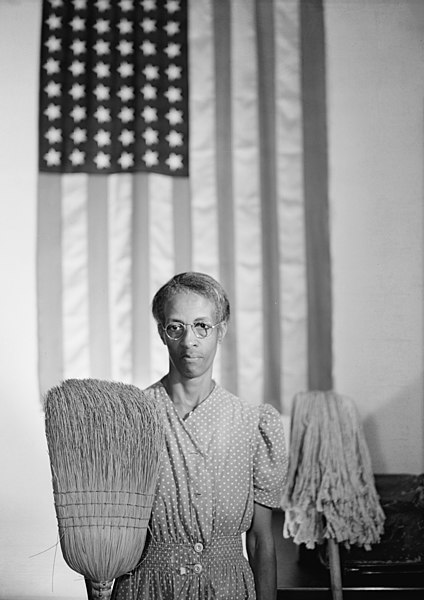 |
| Gordon Parks' American Gothic. Portrait of government cleaning woman Ella Watson. August 1942. (Public domain photo) |
American Gothic, that sounds familiar. What was Parks' inspiration for the title of his photo?
For some background on the American Gothic photograph see the clip below starting at about 19:00.
Share this post with others. See the Twitter, Facebook and other buttons below.
Please follow, add, friend or subscribe to help support this blog.
See more about me at my web site WilliamHartPhD.com.
DigPhotog: Intro to Photography: Mentors - Gordon Parks (U1-P1) Fa14
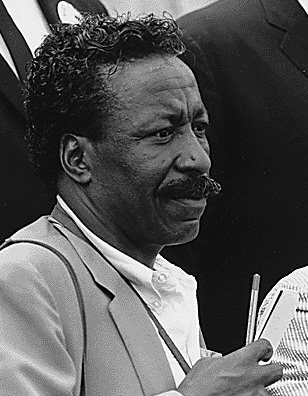 |
| Gordon Parks, 1963, (public domain photo) |
Instead of studying just any photo though, it would be best to start with a study of photographs taken by some of the great photographers.
I'd suggest that you find two or three great photographers that can serve as your mentors. Start by visiting the Masters of Photography site. You may find other similar sites online.
I'd encourage you to consider Gordon Parks as one of your mentors. In addition to being a photographer, Parks was an artist, a composer, an author, and a film director (e.g., Shaft).
Gordon Parks, a Master of the Camera, Dies at 93 (NY Times)
See the clip below from about 11:58 to about 19:00. Wait to view the rest along with a future blog post.
Share this post with others. See the Twitter, Facebook and other buttons below.
Please follow, add, friend or subscribe to help support this blog.
See more about me at my web site WilliamHartPhD.com.
Friday, August 22, 2014
InterculturalCom: Pops and Why Study Intercultural Communication? (U1-P6) Fa14
It is imperative to study intercultural communication.
What does imperative mean? Imperative: "impossible to deter or evade” (Dictionary.com).
How does this relate to the previous post about hazards and benefits?
Source: Intercultural Communication in Context by Martin and Nakayama
"Hey Pops, what do you mean 'A Wonderful World'..."
Share this post with others. See the Twitter, Facebook and other buttons below.
Please follow, add, friend or subscribe to help support this blog.
See more about me at my web site WilliamHartPhD.com.
What does imperative mean? Imperative: "impossible to deter or evade” (Dictionary.com).
- Technological imperative
- technology is increasing intercultural interaction
- Communication Technology
- Transportation Technology
- Demographic imperative (in U.S.)
- U.S. Demographics (e.g., raise in Hispanic pop.)
- Immigration
- Economic imperative (globalization) - to do well in business, it is important
- Peace imperative / "A Wonderful World" (see video below)
- Self-awareness imperative - as we look to better understand others, we also come to better understand ourselves.
- Ethical imperative - it is the right thing to do
How does this relate to the previous post about hazards and benefits?
Source: Intercultural Communication in Context by Martin and Nakayama
"Hey Pops, what do you mean 'A Wonderful World'..."
Share this post with others. See the Twitter, Facebook and other buttons below.
Please follow, add, friend or subscribe to help support this blog.
See more about me at my web site WilliamHartPhD.com.
InterculturalCom: What are the Hazards & Benefits of Studying ICC? (U1-P5) Fa14
 When we are studying intercultural communication, what hazards do we want to be careful to avoid?
What are the benefits of studying intercultural communication? What do we get out of it? How can it help us?
Hazards
- Oversimplification
- Ignore exceptions and subtleties
- Overgeneralizations
- Assume all people that share a culture are the same
- Exaggeration
- Overstate differences between groups of people
Benefits -- Knowledge
- Personal Empowerment
- Freedom from Ignorance
- Productive Relationships
What have been the hazards and benefits for you? Same as above?
 Source: Among Cultures: The Challenge of Communication
 by Brad Hall
(Note: Dr. Brad Hall was an intercultural communication prof of mine while I worked on my Ph.D. at the University of New Mexico.)
Share this post with others. See the Twitter, Facebook and other buttons below.
Please follow, add, friend or subscribe to help support this blog.
See more about me at my web site WilliamHartPhD.com.
InterculturalCom: A Model of ICC (U1-P4) Fa14
How does intercultural communication work? What is the process?

Describe the process shown above. Starts with? Ends with? In the middle?
What stops effective intercultural interaction? What are the bricks in the brick wall? What labels would you put on those bricks?
How would you tear down the wall? What's that mean?
What are the results of effective intercultural interaction? :)

Yes, that's me and the family. The photos are a little older now and so are we.
Share this post with others. See the Twitter, Facebook and other buttons below.
Please follow, add, friend or subscribe to help support this blog.
See more about me at my web site WilliamHartPhD.com.

Describe the process shown above. Starts with? Ends with? In the middle?
What stops effective intercultural interaction? What are the bricks in the brick wall? What labels would you put on those bricks?
How would you tear down the wall? What's that mean?
What are the results of effective intercultural interaction? :)

Yes, that's me and the family. The photos are a little older now and so are we.
Share this post with others. See the Twitter, Facebook and other buttons below.
Please follow, add, friend or subscribe to help support this blog.
See more about me at my web site WilliamHartPhD.com.
InterculturalCom: Cultural Groups: What are Your Cultural Groups? (U1-P3) Fa14
What are your cultural groups? How many cultural groups?

The primary groups are on the inside and the secondary are on the outside.
What is the difference between the primary and secondary groups? Hint: permanencia
With this understanding of your cultural groups, how often are you involved in intercultural communication?


Workforce America!: Managing Employee Diversity as a Vital Resource by Loden and Rosener
Share this post with others. See the Twitter, Facebook and other buttons below.
Please follow, add, friend or subscribe to help support this blog.
See more about me at my web site WilliamHartPhD.com.

The primary groups are on the inside and the secondary are on the outside.
What is the difference between the primary and secondary groups? Hint: permanencia
With this understanding of your cultural groups, how often are you involved in intercultural communication?
Workforce America!: Managing Employee Diversity as a Vital Resource
by Loden and RosenerShare this post with others. See the Twitter, Facebook and other buttons below.
Please follow, add, friend or subscribe to help support this blog.
See more about me at my web site WilliamHartPhD.com.
Subscribe to:
Posts (Atom)