Showing posts with label Unit 7. Show all posts

Tuesday, October 21, 2014

MassMedia: Entertainment: How to Write a Joke (U7-P3) Fa14


“A good joke idea is raw potential and can be used in an almost unlimited number of contexts” (Sankey). Jokes can be used in stand-up comedy, commercials, cartoons, radio shows, a humor column in a newspaper/blog, TV sitcoms, etc. Jokes are the heart of comedy writing.

What is a joke?
  • A funny story.
  • Typically has two parts, the setup and then the punchline.
  • May have an additional part, a tag, which is an additional funny line that follows the punchline.

The Setup:
  • Sometimes called a premise.
  • “A set-up is the information the comic gives to the crowd to establish an initial subject, context and perspective.”
  • Compare this to the Setup in a 3 act film.
  • Henny Youngman’s old joke
    • The setup: “Women are crazy today.”

The Punchline:
  • “the final information the comic gives to the crowd; it alters the meaning of already given information in a surprising fashion.”
  • Compare punchlines to plot points.
  • Henny Youngman’s old joke
    • The punchline: “Take my wife………please”


Do you spot the setups and punchlines in the following Bud Light commercials? Spot the tags in some? Don't need to watch them all, just a few will do.  Watch responsibly.

Bud Light commercials deserve some ideological criticism?

Now, let's take a look at the joke structure in a situation comedy.  Just check out the first minute or so. How many jokes in the first minute?  Wonder how many jokes in a typical sitcom?  Could you write for a sitcom? Can you write a joke?


Share this post with others. See the Twitter, Facebook and other buttons below.
Please follow, add, friend or subscribe to help support this blog.
See more about me at my web site WilliamHartPhD.com.


MassMedia: Entertainment: Is Reality TV Real? (U7-P2) Fa14

Within entertainment television, one of the increasingly popular genres is reality TV.

Reality TV: "a genre of television programming that presents purportedly unscripted dramatic or humorous situations, documents actual events, and usually features ordinary people instead of professional actors.”

Unscripted?  Really?

In the video clip below, pay particular attention to the comments about writing dialogue, creating a setup and conflict.  Sound familiar?


More on the writing and creating of reality TV shows.  In the video below, pay particular attention from 1:09 to 3:15.  Note the speakers mention of archetypal roles and frankenbites.  What does he mean by a frankenbite?


The clips above suggest that during the production of a reality TV episode, "writers" sometimes write dialogue for the "actors" and do things to create conflict.

However, it is in post-production, where a lot of the creating or writing of the story happens.  In post-production, the producers and "writers" have to put together the best material to tell the best story.  The post-production process would begin with (1) the screening of 100s of hours of raw footage, (2) identifying a story that they want to tell, and (3) try to thread that story through the acts of episode.

The common parts of a story: introduction of character, explain the problem or need, face the obstacles to overcoming that problem, the character does or does not solve their problem.  This sound familiar?

One of the videos above, suggests that it is in post-production where some creative editing can happen. Frankenbites, for example?

Could you write a reality TV series?  An interesting challenge, yes?  How would it be similar to and different from the writing of fictional TV?


Share this post with others. See the Twitter, Facebook and other buttons below.
Please follow, add, friend or subscribe to help support this blog.
See more about me at my web site WilliamHartPhD.com.


Monday, October 20, 2014

MassMedia: Entertainment: Hero's Journey (U7-P1) Fa14


Previously, we've covered how to write a story based on the three-act structure (e.g., Syd Field's approach). Now let's take a look at a different way of writing a story. Joseph Campbell first identified what he called the Hero's Journey, common story structure found around the world. He found this common story structure in a vast number of old myths from around the world.  Some film directors started using Campell's work when they were writing their own stories.  The most famous example of a film which was shaped by Campbell's work is George Lucas' Star Wars. After the success of Star Wars, many script writers began using the Campbell's ideas. Today there are a number of books on how to use Cambell's ideas in script writing.

However, let's skip the books and get some insight from the videos below.

Let's start with archetypal characters found in many stories.


Now with an understanding of the common archetypal characters, let's look specifically at the hero's journey itself.


You spot the Hero's Journey in any of your favorite films?


Share this post with others. See the Twitter, Facebook and other buttons below.
Please follow, add, friend or subscribe to help support this blog.
See more about me at my web site WilliamHartPhD.com.


Friday, October 17, 2014

InterculturalCom: Intercultural Romance: Activity: WWYD? (U7-U4) Fa14


The ABC series What Would You Do?  provides us with a critical incident to analyze for intercultural/interracial romances.


What would you do?  Why?
Other thoughts about this ABC clip?

And now this WWYD? critical incident:


WWYD?


Share this post with others. See the Twitter, Facebook and other buttons below.
Please follow, add, friend or subscribe to help support this blog.
See more about me at my web site WilliamHartPhD.com.


InterculturalCom: Intercultural Romance: Activity: Loving v. Virginia (U7-P3) Fa14


How do the state laws like the ones in Virginia fit into the previous discussion of internal and external barrier?

If you are curious:

Share this post with others. See the Twitter, Facebook and other buttons below.
Please follow, add, friend or subscribe to help support this blog.
See more about me at my web site WilliamHartPhD.com.


InterculturalCom: Intercultural Romance: Jungle Fever and Barriers to Interracial Marriage (U7-P2) Fa14


As the number of interracial marriages has increased so too has the approval of interracial marriages.  In the late 1950s less than 10% of the U.S. population approved of interracial marriages.  By 2007, the approval rating was almost 80%.


So, still with a significant portion of the U.S. population disapproving interracial marriages, couples in such marriages face some unnecessary challenges.  Besides the normal challenges of any relationship, an interracial or intercultural relationship faces two additional barriers to a healthy relationship: internal barriers and external barriers.

The internal barriers are those of any intercultural interaction.

How does intercultural communication work? What is the process?
Two people from different cultures interact, but there are barriers to effective intercultural communication.  Some of the barriers include: difference in language, difference in nonverbals, difference in values, ethnocentrism and prejudice.


In addition to the above an interracial couple may also face some external barriers.


If you get a chance to watch or re-watch Jungle Fever, see if you spot the internal and external barriers.

You may also want to see the intercultural relationship in The Joy Luck Club.

Can you think of more recent films that show the internal and external barriers that interracial and intercultural couples face?


------- FROM TWITTER:


Share this post with others. See the Twitter, Facebook and other buttons below.
Please follow, add, friend or subscribe to help support this blog.
See more about me at my web site WilliamHartPhD.com.


InterculturalCom: Intercultural Romance: Jungle Fever and Interracial Marriage (U7-P1) Fa14

Note: Click on images to see large size.


The above painting is "Othello and Desdemona" by Chasserieu from the early 1800s.  It is inspired by William Shakespeare's play Othello from approximate 1603. In the painting are Othello, the Moor and Desdemona, his Venetian wife.


The title "Jungle Fever" comes from a 1991 Spike Lee film.  More on the Jungle Fever film later.


Let's turn now to the topic of interracial marriages in the United States.  Over the past few decades there has been strong growth in the number of interracial marriages from less than 1% in 1970 to approximately 10% in 2010.  In the U.S today more than 1 in 10 marriages are interracial marriages.


When you look at the number of unmarried couples the percentage of interracial couples is even higher.

Info source | Photo credit: J


Info source | Photo credit: Salihan Laugesen 


Share this post with others. See the Twitter, Facebook and other buttons below.
Please follow, add, friend or subscribe to help support this blog.
See more about me at my web site WilliamHartPhD.com.


Tuesday, October 14, 2014

MediaTech: Cell Phones, Popcorn and the Consequences of Cell Phone Tech (U7) [VID] Fa14


If I say popcorn and cell phones, what pops into your mind?

Seen the videos on the Internet that show people using cell phones to pop popcorn?

Are there health concerns you have when using cell phones?
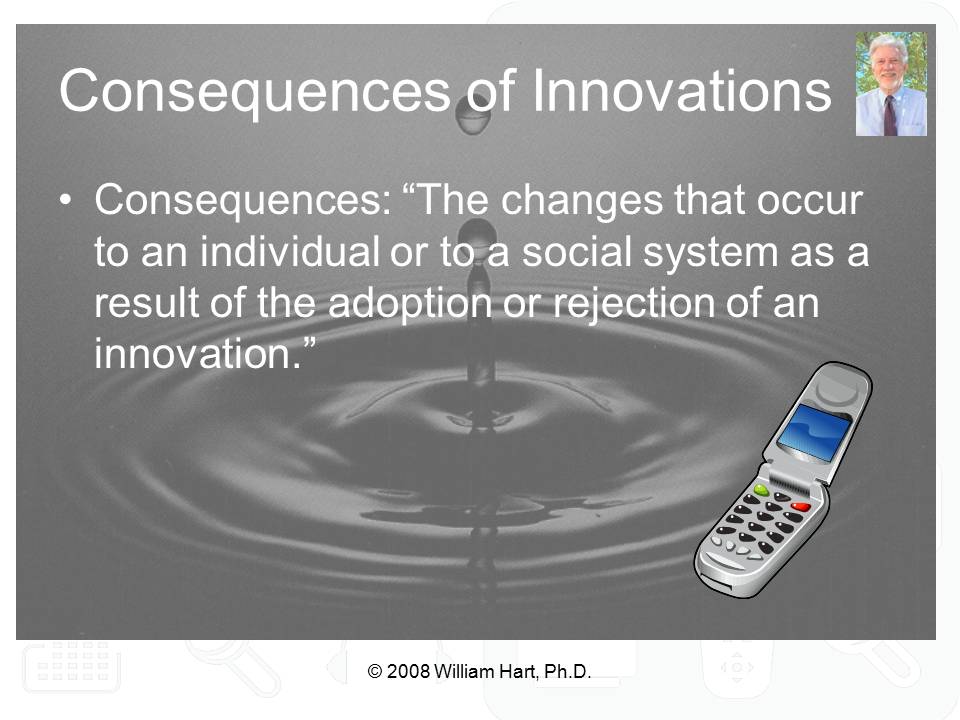
That is, is there a serious consequence of us adopting cell phones?

Be sure to stop the video at 3 minutes in and do a little thinking.


Share this post with others. See the Twitter, Facebook and other buttons below.
Please follow, add, friend or subscribe to help support this blog.
See more about me at my web site WilliamHartPhD.com.


Saturday, October 11, 2014

MediaTech: Cell Phones and the Consequences of Tech: Cell Phones, Smartphones and Media Convergence (U7-P4) Fa14


What is a smartphone?

"A cellular telephone with built-in applications and Internet access. In addition to digital voice service, modern smartphones provide text messaging, e-mail, Web browsing, still and video cameras, MP3 player and video playback and calling. In addition to their built-in functions, smartphones run myriad free and paid applications, turning the once single-minded cellphone into a mobile personal computer. For an overview of included and nice-to-have features..." (PCMag.com)

What's the difference between a cell phone and a smartphone?  How does a dumb phone fit in here?  

How does the banana phone fit in?  :)


Recalling, the previous discussion on consequences, what are some consequences of adopting a smartphone?


Share this post with others. See the Twitter, Facebook and other buttons below.
Please follow, add, friend or subscribe to help support this blog.
See more about me at my web site WilliamHartPhD.com.


MediaTech: Cell Phones and the Consequences of Tech: More on Digital Divide (Rogers) (U7-P3) Fa14

Why is there a digital divide?  There are many answers to that, but one way to look at it is to see it in the context of the diffusion of innovations.
Put another way, 
  • those with cash can afford to get the costly innovation.  Price usually higher at first.  
  • Change agents (in this case: marketers, advertisers, sales people), focus on those people with the cash.  So, maybe only those with the cash, learn about the product.
  • Those with cash, tell those with cash.
  • If those with cash get adopt the innovation, then they benefit from it.  Imagine when cell phone just came out.  Those who could afford to buy the cell phone had advantages over those people who could not afford it.  Maybe those with cash can more easily get there business phone calls and then make even more money. Those who did not have the cell phone missed that important business call and lost the money.
  • Imagine this process repeating again and again.  The gap between the two groups widens.  


How to fix this gap, this digital divide?


Share this post with others. See the Twitter, Facebook and other buttons below.
Please follow, add, friend or subscribe to help support this blog.
See more about me at my web site WilliamHartPhD.com.


MediaTech: Cell Phones and the Consequences of Tech: The Digital Divide (U7-P2) Fa14


Quickly browse some the Current News on the Digital Divide


Share this post with others. See the Twitter, Facebook and other buttons below.
Please follow, add, friend or subscribe to help support this blog.
See more about me at my web site WilliamHartPhD.com.


MediaTech: Cell Phones and the Consequences of Tech: Types of Consequences (Rogers) (U7-P1) Fa14


Think of desirable and undesirable consequences as the good and bad consequences of adopting an innovation.  Desirable = good, positive.  Undesirable = bad, negative.

What would be some desirable or good consequences of university students adopting cell/smart phones?
What would be some undesirable consequences?


As for direct and indirect, think of consequences as chain of consequences.

Adopt an innovation ---> direct consequence  ---> indirect consequence  -----> indirect consequence.

For example, if you adopt a new 3-D HDTV, then you can then you invite all your friends over and be "the talk of the town."  Now, that you are popular among your friends, you fell the pressure to keep inviting your new "friends" over (indirect consequence).  Now you lose time and money time and money entertaining your new friends (indirect consequence).  Which leads to you not having the time to spend on other important things in your life (indirect consequence).  The loss of time is not a direct consequence, but an indirect consequence.

Anticipated consequences are those that you think are going to happen if you adopt the innovation.  The unanticipated consequences are those that you don't see coming.  For example, you adopt that newest, expensive, tech toy and it is great.  You can do all sorts of things with it.  However, you didn't think about the struggle of paying off the bill for the new toy.


Share this post with others. See the Twitter, Facebook and other buttons below.
Please follow, add, friend or subscribe to help support this blog.
See more about me at my web site WilliamHartPhD.com.


Monday, March 17, 2014

GlobalMedia: Development Communication (cont'd): Entertainment Education (U7-P1) Sp14


The idea of presenting a development message within a fictional program is the type of development communication that is called entertainment education.  The World Bank is a multinational organization that uses entertainment education in their work.  See the video below for examples and background information.


Below is another example of entertainment education.  Tim Reid, noted Norfolk State University alumnus and actor/director/producer, and NSU students (Maryna Kariuk and Shimira Cole) were involved in the making of "Hear My Son".  How exactly is this an example of entertainment education?


Hear My Son from Legacy Media Institute on Vimeo.


Interested in learning more about entertainment education, I'd recommend starting with a book edited by Arvind Singhal, Michael J. Cody, Everett M. Rogers and Miguel Sabido called
Entertainment-Education and Social Change: History, Research, and Practice (Routledge Communication Series)


Share this post with others. See the Twitter, Facebook and other buttons below.
Please follow, add, friend or subscribe to help support this blog.
See more about me at my web site WilliamHartPhD.com.


Tuesday, October 8, 2013

InterculturalCom: Cultural Identity and The Debut: Minority Identity Development (U7-P2) fa13


Note: Click on images to see a larger version.


Source: Intercultural Communication in Contexts by Martin and Nakayama


Share this post with others. See the Twitter, Facebook and other buttons below.
Please follow, add, friend or subscribe to help support this blog.
See more about me at my web site WilliamHartPhD.com.


InterculturalCom: Cultural Identity and The Debut (U7-P1) fa13


An excellent way to explore the topics related to cultural identity is by watching The Debut.

Besides helping us to understand cultural identity, the film also allows to learn some about Filipino culture.

Here are some Filipino cultural literacy to learn from the film.
  • Tagalog: main language
  • Barkada: peer group
  • Oo: yes
  • Singkil: "the stick dance"
Collectivism/Individualism Through Dance 
See this video I posted on YouTube.  How does it relate to the film?


The above clip is from I'm Normal, You're Weird! Understanding Other Cultures. This was an excellent teaching resource.  I wish that it was released in some form on DVD.


Do you spot the following Filipino values?
  • Family/Group (Authority)
  • Food
  • Education/Success

Also, what do you notice in the film about Filipino "Time Orientation"?


Share this post with others. See the Twitter, Facebook and other buttons below.
Please follow, add, friend or subscribe to help support this blog.
See more about me at my web site WilliamHartPhD.com.


Thursday, April 4, 2013

GlobalMedia: International Public Relations: Case Study of U.S. Military Image in Afghanistan (U7-P4)


A case study is a method of teaching in which students are presented with a problematic scenario or case.  A case is an example or illustration of a problem or challenge.

Case studies are some times used in law classes and some times in public relations classes, for example.

After an international case is presented there is a common method used in PR courses.
  1. Define/describe the PR problem.
  2. Give ways for addressing or solving this problem.
  3. List resources needed for implementing solution(s).
  4. Give a timetable for implementation.
  5. State expected impact of solution.
  6. How did you use intercultural skills?

Intercultural skills to keep in mind when working through the international P.R. case
  • Be mindful
    • Be thoughtful, aware of differences
  • Be patience
    • It may be difficult at first
  • Be open-minded
    • Consider other ways of doing things, other views
  • Be tolerance of ambiguity
    • Things may not make sense. Be comfortable with uncertainty

Now, let's do a case or three.
Check out the following news videos about three back-to-back incidents between the U.S. military and the people of Afghanistan in early 2012.  As you are watching these, starting thinking about the above info.  What would you do to rebuild a better relationship between the U.S. military and the people of Afghanistan?


Pentagon denounces Marine urination video (CBS Evening News - Jan. 2012)


Quran Burning Sparks Angry Afghan Protest (Associated Press - Feb. 2012)


Afghan Massacre: Video From Shooting Scene (ABC Evening News - Mar. 2012)


What would you do to rebuild a better relationship between the U.S. military and the people of Afghanistan?

Also, now go through the method given above (i.e., 1. Define/describe the P.R. problem, etc.).  Also don't forget to think about how you'd use your intercultural skills in doing this P.R. work.


Share this post with others. See the Twitter, Facebook and other buttons below.
Please follow, add, friend or subscribe to help support this blog.
See more about me at my web site WilliamHartPhD.com.


Sunday, March 31, 2013

GlobalMedia: Doing Some P.R. Work for the U.S. State Department (U7-P3) Sp13


Let's pretend that we are doing some public relations/advertising work for the U.S. State Department.  They want us to (1) promote a good image of the U.S. abroad and (2) promote tourism to the U.S.

What could we do?  How would we do that?

Where would we do that?  Let's say we focus on places where people first have contact with the U.S., in airports and in U.S embassies abroad.

As for the what, how about we put together a short video to be shown in the airports and embassies.

Think very carefully about what you would be in that video and why.

No, no.  Don't read on.  Seriously, think about what you'd put in the video and why.

O.K., now read on.
---

This above scenario actually played out few years back.  It actually happened.  Let's see how your ideas match up with those actually carried out.  Let's look at a series of videos.

A CNN News Report


The Actual Video Shown in Airports and Embassies
(See at least the first minute and the last minute to get a good feel for the video.)


The Making of the Portraits of America Video


Do you think this "Portraits of America" video was effective, based upon what you've see above?
Would you have done anything differently?


Share this post with others. See the Twitter, Facebook and other buttons below.
Please follow, add, friend or subscribe to help support this blog.
See more about me at my web site WilliamHartPhD.com.


GlobalMedia: International Advertising & Public Relations: Campaigns & Culture (U7-P2) Sp13


A campaign is “an operation or series of operations energetically pursued to accomplish a purpose: an advertising campaign for a new product; a candidate's political campaign” (American Heritage Dictionary)

An advertising campaign for a certain new product could contain a "series of operations" like

  • putting out press releases to the news media,
  • putting ads in newspapers and
  • posting a viral video on YouTube about the new product.

The purpose of all these "operations" is to encourage purchase of the product.

Now, what about going global?


According to McPhail,
"There are three strategic models for planning global campaigns: standardized, adaptive, and country-specific.  In the standardized model, strategy is formed at the global headquarters and implemented in all operating areas [same or very similar in all countries].  In the adaptive model, a basic strategy [given from head-quarters] is adapted appropriately for each country where it will be implemented.  In a country-specific model, the strategic planning is shaped to fit one country [,more grass-roots]" (Global Communication: Theories, Stakeholders, and Trends)


Let's say we are doing advertising for the multinational corporation, McDonald's.  As part of the campaign that we are managing, they want 30 second TV ads for their new salads.  They want to sell salads (or localized versions of salads) around the world in many different countries.  Using each of the above models, how would this be done?  See any benefits or drawbacks to each approach?  What about in terms of costs and effectiveness?


Share this post with others. See the Twitter, Facebook and other buttons below.
Please follow, add, friend or subscribe to help support this blog.
See more about me at my web site WilliamHartPhD.com.


GlobalMedia: International Advertising & PR (U7-P1) Sp13


Advertising and public relations are playing an increasing role in international communication.  They've certainly gone global.

Let's start with some basic dictionary definitions.

Advertising: “The activity of attracting public attention to a product or business, as by paid announcements in the print, broadcast, or electronic media” (The American Heritage Dictionary).

Public Relations (P.R.): “The methods and activities employed to establish and promote a favorable relationship with the public” (The American Heritage Dictionary).

The basic dictionary definitions need a little modifying.
  • Add to the advertising definition, the key purpose of advertising: to persuade people to purchase.  "Attraction public attention" is a good first step, but not the ultimate goal.
  • Add to the P.R. definition, the idea of establishing, promoting and maintaining a relationship.  Secondly, add an "s" to the end of public.  What are the key publics that a company needs to have a good relationship with?  Externally: the government/law makers, other companies, customers, the media, etc. Internally: investors, employees, etc.
If you are curious, checkout some more online definitions of advertising and public relations.


With some basics out of the way, let's go global with advertising and P.R.


In his book, Global Communication: Theories, Stakeholders, and Trends, Thomas McPhail offers three key reasons why there has been a growth in international advertising and P.R.  Why has advertising and public relations gone global?

"1. Corporations themselves are going increasingly global and taking their advertising agencies with them.  This includes communication corporations as well as other sectors such as transportation, food, beverages, natural resources, credit cards, etc.
2. As multimedia outlets -- from privatized radio and television networks in Europe to new media and print outlets in Latin America -- expand, they require successful advertising campaigns in order to generate the revenues and attract new customers necessary to succeed as viable commercial enterprises.
3. The growth of satellite-delivered broadcasting channels, along with a rapid expansion of cable systems and networks, have in turn generated demand for increased use of advertising agencies in order to develop a sufficient customer base for either the new services themselves, or the problems they advertise."

Note that the first reason focuses on general companies, the second reason focuses on media companies that provide content and the third reason focuses on the media hardware companies.


In their book, Global Journalism: Topical Issues and Media Systems (4th Edition), de Beer and Merrill offer their own explanation for the expansion of international advertising and public relations.

Why the expansion?

  • Financial businesses, etc.
    • Economically connected
    • In short, business is global
  • Issues management & crisis management
    • Crises spread quickly on the ‘Net nowadays.
    • Some crises, like environmental and financial crises, easily cross borders.
    • In short, many issues/crises are global

In short, P.R. and advertising have to go global.


Share this post with others. See the Twitter, Facebook and other buttons below.
Please follow, add, friend or subscribe to help support this blog.
See more about me at my web site WilliamHartPhD.com.


Wednesday, October 17, 2012

MediaTech: TV Tech: How HDTV Works (U7-P6) [VID] fa12


Share this post with others. See the Twitter, Facebook and other buttons below.
Please follow, add, friend or subscribe to help support this blog.
See more about me at my web site WilliamHartPhD.com.