Monday, April 1, 2019

MediaResearch: Surveys: What Are They And How To Do Them. (W13-P1) Sp19


What is a survey? 

A research method in which respondents representing a specific population are asked questions concerning their knowledge, beliefs, attitudes, and behaviors (based on FBFK).

Scholarly use: e.g., correlational design.

Types of applied use: e.g.,  political polls and market research (e.g., Nielsen)

What are the general steps in constructing and giving a survey?

  1. Identify the purpose of the survey
    1. What is the ultimate purpose of a survey in a research study?
  2. Determine who to ask and what to ask.
  3. Write survey
  4. Give survey
    1. Let participants know if there are any risks.
    2. Let participants know their rights.
    3. Right to not participate, to stop participating, etc.
    4. Thank the participants.
  5. Tally results
  6. Report results


What information should be included on a survey (excluding survey questions)?

Title: A Study of Social Media Use by College Students
Who: Dr. Hart, Department of Mass Communications & Journalism
Where:  Norfolk State University, Norfolk, VA
Any Questions: Send to Dr. Hart
Statement of Purpose:
This study seeks your opinion about methods courses for a research study. Your responses are anonymous.  Thank You.
Rights: In addition, if for whatever reason you do not feel comfortable responding to any or all items, please leave it(them) blank.


To be continued...


Share this post with others. See the Twitter, Facebook and other buttons below.
Please follow, add, friend or subscribe to help support this blog.
See more about me at my web site WilliamHartPhD.com.


Saturday, March 30, 2019

MediaResearch: Validity, Reliability, Etc.: Internal and External Validity + Sampling (W12-P2) Sp19


Sampling

Sampling is the process of selecting subjects for a study.  Generally, the subjects are the specific people studied in an experiment or surveyed.  The sample is chosen out of a larger population.

Why sample?  The population you are studying is too large to study, so you have to study just a part of that population (a sample).

What could be some problems with sampling (examples of poor sampling)?  Bias sample?

To reduce the problems of poor sampling, you want to use random sampling when you can.  In random sampling all members of a population have an equal chance of getting into sample.


------------


What are internal and external validity?

With this type validity we are looking at the validity of the overall study, not just the validity of the instruments being used to measure the variables.

You are asking the question: Is it a valid study? Not: Is it a valid instrument?


Internal validity: Are the conclusions to be trusted for the particular study?  Or, are the results valid for the subjects in your sample.   For a visual representation just look the orange circle at the top. The black dots inside the orange circle are the subjects in the sample.


External validity: To whom do the conclusions apply? Generalizability of findings.  The results, can they be generalized to the larger populations   For a visual representation see the orange circle within the pinkish-purple circle.  The orange circle represents the sample and pinkish-purple circle represents the larger population.


Question: Could you have very poor internal validity, but good external validity?

--------

If something goes wrong in a study, who can you blame it on?   That is, if the study is not getting valid results, who can you blame it on? And you can't blame it on the alcohol.  :)

What are some threats to a study’s internal validity?   Or, put another way, where can you put the blame?
  • Threats due to researcher (e.g., influence results).  
  • Threats due to how research is conducted (e.g., inaccurate, inconsistent research, poorly designed survey)
  • Threats due to research subjects
    • Hawthorne effect
    • mortality - losing people from a study (due to death, etc.)
    • maturation - internal change explains behavior.  In studies done over a period of time the subjects may change.
Example: 4 year study of film viewing and levels of prejudice. Subjects= college students.
See any possible threats to internal validity?


What are some threats to a study’s external validity?
  • Research procedures don’t reflect everyday life
    • ecological validity
  • Different finding, same sample
    • replication is important
  • Poor sampling


Any problems with studies done at universities?
Generalizability problem?


Share this post with others. See the Twitter, Facebook and other buttons below.
Please follow, add, friend or subscribe to help support this blog.
See more about me at my web site WilliamHartPhD.com.


MediaResearch: Validity, Reliability, Etc.: Definitions (Written and Visual) (W12-P1) Sp19


You operationalize your variables in order to measure them.
So, now let's talk about measurement and related concepts.

When measuring your variables you may ask yourself...
Is my measure “on target”?   That is, are my measurements accurate?
Do my measures “cluster together”?  That is, am I getting consistent results?

But what does that mean?

What we are talking about is validity and reliability.

Let's start by thinking about how to measure prejudice in people. How would you do that? A survey? What would the questions be on the survey?  Your measure of prejudice needs to be valid and reliable.  Are you sure they are valid and reliable?   Are you accurately measure the level of prejudice in a person with your survey?  Does your survey get the same results with the same person each time?


Validity: “the extent that scales or questions do measure what they are thought to measure”(Stacks & Hocking).

You can think of validity using a target metaphor.  Is it on target (i.e.,  near the bulls eye)?
Each "shot" on the target represents a measurement.


Or think of a bathroom scale.  What does it meen to say a bathroom scale is valid or not?


2012_May_03_Bathroom Scale_008
Photo by elcamino73. Used under Creative Commons.

If you get on your bathroom scale and it says 3 pounds or 1723 pounds, then your scale is broken. It is not right.  It is not valid.  Not only is your scale broken, the results (3, 1723) are not valid measures of your weight.

------------------

A related concept to validity is reliability.

Before looking at a formal definition of reliability, just think of the everyday use of that word.  If you say your friend is reliable, what does that mean?   It means you can count on your friend. Every time that you call on that friend they are there.  Not sometimes.  All the time.  They are consistent.  The formal definition of reliability is similar.

Reliability: “the extent to which measurement yields numbers (data) are consistent, stable, and dependable.” (Stacks & Hocking).

Again, let's use some metaphors to see the concept.
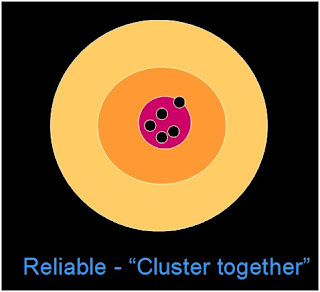


What about a bathroom scale and reliability?  What does it mean to say that a bathroom scale is reliable?


2012_May_03_Bathroom Scale_008
Photo by elcamino73. Used under Creative Commons.


Can an instrument can be reliable, but not valid. That is, cluster together, but not be on target?


If you had a bathroom scale that was reliable, but not valid, what results would you get if you weighted yourself several times?


Example

Let's say we are interested in the topic of communication apprehension.  More specifically, we are interested in the relationship between gender and communication apprehension.  Do men or women have higher levels of communication apprehension?  How would we go about answering that question?

How would we measure communication apprehension in our subjects (the people we are studying)?  We could observe.  What about a survey?  Yeah, let's do a survey.  Something like below.

-------------------------------------
Conversation Apprehension Scale

1. While participating in a conversation with a new acquaintance, I feel very nervous.
Strongly Agree --- Moderately Agree --- Neutral --- Moderately Disagree --- Strongly Disagree

2. I have no fear of speaking up in conversations.
Strongly Agree --- Moderately Agree --- Neutral --- Moderately Disagree --- Strongly Disagree

3. Ordinarily I am very tense and nervous in conversations.
Strongly Agree --- Moderately Agree --- Neutral --- Moderately Disagree --- Strongly Disagree

4. Ordinarily I am very calm and relaxed in conversations.
Strongly Agree --- Moderately Agree --- Neutral --- Moderately Disagree --- Strongly Disagree

------------------------------------


Think of this survey as a measuring instrument, just like a bathroom scale. The bathroom scale measures your weight and this survey would measure your communication apprehension.

Does our instrument (the above survey) have good measurement validity and measurement reliability? How would you determine that?

Measurement validity:
“the extent to which researchers are actually measuring the concepts they intend to measure”(FBFK)
Do the instruments give accurate/true readings?

Measurement reliability:
“the extent to which measurements of a variable are consistent and trustworthy”(FBFK)
Do the instruments continue to give the same readings every time they are used?


What are the procedures for checking an instrument’s reliability?

Similar results every time?
0% = Not reliable to 100% highly reliable

Three Ways to Check Instrument’s Reliability
1. Test and retest it.
2. Test, change wording slightly, retest.
3. Compare 1/2 items to the other 1/2

3 options, Not step-by-step
Which option is best?  Costs and benefits?

--------------


Share this post with others. See the Twitter, Facebook and other buttons below.
Please follow, add, friend or subscribe to help support this blog.
See more about me at my web site WilliamHartPhD.com.