Showing posts with label Unit 7-Post 1. Show all posts

Monday, October 20, 2014

MassMedia: Entertainment: Hero's Journey (U7-P1) Fa14


Previously, we've covered how to write a story based on the three-act structure (e.g., Syd Field's approach). Now let's take a look at a different way of writing a story. Joseph Campbell first identified what he called the Hero's Journey, common story structure found around the world. He found this common story structure in a vast number of old myths from around the world.  Some film directors started using Campell's work when they were writing their own stories.  The most famous example of a film which was shaped by Campbell's work is George Lucas' Star Wars. After the success of Star Wars, many script writers began using the Campbell's ideas. Today there are a number of books on how to use Cambell's ideas in script writing.

However, let's skip the books and get some insight from the videos below.

Let's start with archetypal characters found in many stories.


Now with an understanding of the common archetypal characters, let's look specifically at the hero's journey itself.


You spot the Hero's Journey in any of your favorite films?


Share this post with others. See the Twitter, Facebook and other buttons below.
Please follow, add, friend or subscribe to help support this blog.
See more about me at my web site WilliamHartPhD.com.


Friday, October 17, 2014

InterculturalCom: Intercultural Romance: Jungle Fever and Interracial Marriage (U7-P1) Fa14

Note: Click on images to see large size.


The above painting is "Othello and Desdemona" by Chasserieu from the early 1800s.  It is inspired by William Shakespeare's play Othello from approximate 1603. In the painting are Othello, the Moor and Desdemona, his Venetian wife.


The title "Jungle Fever" comes from a 1991 Spike Lee film.  More on the Jungle Fever film later.


Let's turn now to the topic of interracial marriages in the United States.  Over the past few decades there has been strong growth in the number of interracial marriages from less than 1% in 1970 to approximately 10% in 2010.  In the U.S today more than 1 in 10 marriages are interracial marriages.


When you look at the number of unmarried couples the percentage of interracial couples is even higher.

Info source | Photo credit: J


Info source | Photo credit: Salihan Laugesen 


Share this post with others. See the Twitter, Facebook and other buttons below.
Please follow, add, friend or subscribe to help support this blog.
See more about me at my web site WilliamHartPhD.com.


Saturday, October 11, 2014

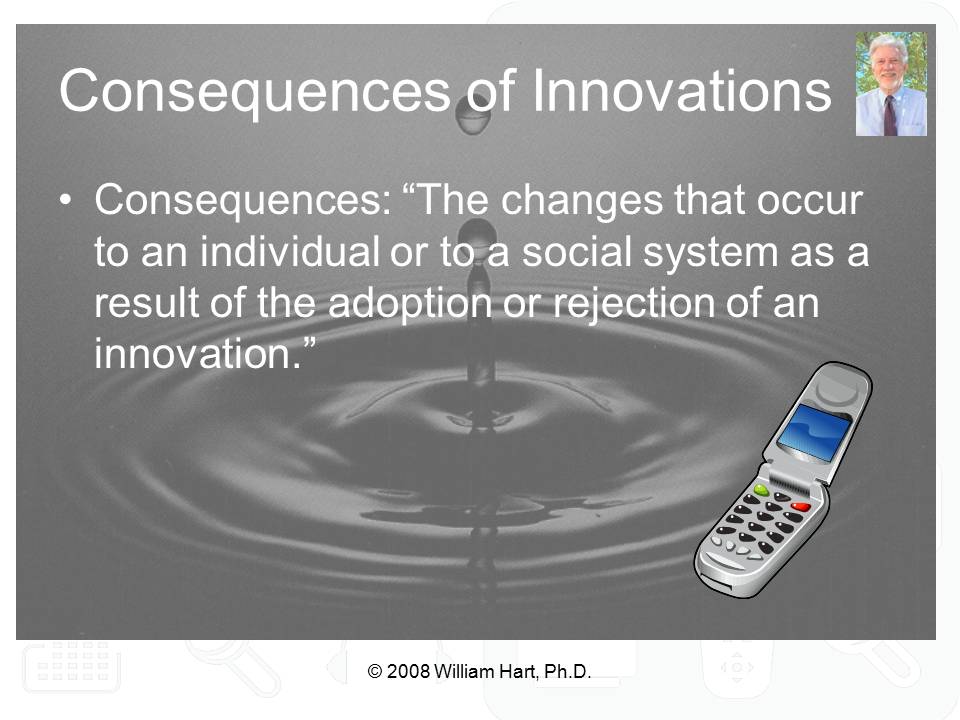
MediaTech: Cell Phones and the Consequences of Tech: Types of Consequences (Rogers) (U7-P1) Fa14


Think of desirable and undesirable consequences as the good and bad consequences of adopting an innovation.  Desirable = good, positive.  Undesirable = bad, negative.

What would be some desirable or good consequences of university students adopting cell/smart phones?
What would be some undesirable consequences?


As for direct and indirect, think of consequences as chain of consequences.

Adopt an innovation ---> direct consequence  ---> indirect consequence  -----> indirect consequence.

For example, if you adopt a new 3-D HDTV, then you can then you invite all your friends over and be "the talk of the town."  Now, that you are popular among your friends, you fell the pressure to keep inviting your new "friends" over (indirect consequence).  Now you lose time and money time and money entertaining your new friends (indirect consequence).  Which leads to you not having the time to spend on other important things in your life (indirect consequence).  The loss of time is not a direct consequence, but an indirect consequence.

Anticipated consequences are those that you think are going to happen if you adopt the innovation.  The unanticipated consequences are those that you don't see coming.  For example, you adopt that newest, expensive, tech toy and it is great.  You can do all sorts of things with it.  However, you didn't think about the struggle of paying off the bill for the new toy.


Share this post with others. See the Twitter, Facebook and other buttons below.
Please follow, add, friend or subscribe to help support this blog.
See more about me at my web site WilliamHartPhD.com.


Monday, March 17, 2014

GlobalMedia: Development Communication (cont'd): Entertainment Education (U7-P1) Sp14


The idea of presenting a development message within a fictional program is the type of development communication that is called entertainment education.  The World Bank is a multinational organization that uses entertainment education in their work.  See the video below for examples and background information.


Below is another example of entertainment education.  Tim Reid, noted Norfolk State University alumnus and actor/director/producer, and NSU students (Maryna Kariuk and Shimira Cole) were involved in the making of "Hear My Son".  How exactly is this an example of entertainment education?


Hear My Son from Legacy Media Institute on Vimeo.


Interested in learning more about entertainment education, I'd recommend starting with a book edited by Arvind Singhal, Michael J. Cody, Everett M. Rogers and Miguel Sabido called
Entertainment-Education and Social Change: History, Research, and Practice (Routledge Communication Series)


Share this post with others. See the Twitter, Facebook and other buttons below.
Please follow, add, friend or subscribe to help support this blog.
See more about me at my web site WilliamHartPhD.com.


Tuesday, October 8, 2013

InterculturalCom: Cultural Identity and The Debut (U7-P1) fa13


An excellent way to explore the topics related to cultural identity is by watching The Debut.

Besides helping us to understand cultural identity, the film also allows to learn some about Filipino culture.

Here are some Filipino cultural literacy to learn from the film.
  • Tagalog: main language
  • Barkada: peer group
  • Oo: yes
  • Singkil: "the stick dance"
Collectivism/Individualism Through Dance 
See this video I posted on YouTube.  How does it relate to the film?


The above clip is from I'm Normal, You're Weird! Understanding Other Cultures. This was an excellent teaching resource.  I wish that it was released in some form on DVD.


Do you spot the following Filipino values?
  • Family/Group (Authority)
  • Food
  • Education/Success

Also, what do you notice in the film about Filipino "Time Orientation"?


Share this post with others. See the Twitter, Facebook and other buttons below.
Please follow, add, friend or subscribe to help support this blog.
See more about me at my web site WilliamHartPhD.com.


Sunday, March 31, 2013

GlobalMedia: International Advertising & PR (U7-P1) Sp13


Advertising and public relations are playing an increasing role in international communication.  They've certainly gone global.

Let's start with some basic dictionary definitions.

Advertising: “The activity of attracting public attention to a product or business, as by paid announcements in the print, broadcast, or electronic media” (The American Heritage Dictionary).

Public Relations (P.R.): “The methods and activities employed to establish and promote a favorable relationship with the public” (The American Heritage Dictionary).

The basic dictionary definitions need a little modifying.
  • Add to the advertising definition, the key purpose of advertising: to persuade people to purchase.  "Attraction public attention" is a good first step, but not the ultimate goal.
  • Add to the P.R. definition, the idea of establishing, promoting and maintaining a relationship.  Secondly, add an "s" to the end of public.  What are the key publics that a company needs to have a good relationship with?  Externally: the government/law makers, other companies, customers, the media, etc. Internally: investors, employees, etc.
If you are curious, checkout some more online definitions of advertising and public relations.


With some basics out of the way, let's go global with advertising and P.R.


In his book, Global Communication: Theories, Stakeholders, and Trends, Thomas McPhail offers three key reasons why there has been a growth in international advertising and P.R.  Why has advertising and public relations gone global?

"1. Corporations themselves are going increasingly global and taking their advertising agencies with them.  This includes communication corporations as well as other sectors such as transportation, food, beverages, natural resources, credit cards, etc.
2. As multimedia outlets -- from privatized radio and television networks in Europe to new media and print outlets in Latin America -- expand, they require successful advertising campaigns in order to generate the revenues and attract new customers necessary to succeed as viable commercial enterprises.
3. The growth of satellite-delivered broadcasting channels, along with a rapid expansion of cable systems and networks, have in turn generated demand for increased use of advertising agencies in order to develop a sufficient customer base for either the new services themselves, or the problems they advertise."

Note that the first reason focuses on general companies, the second reason focuses on media companies that provide content and the third reason focuses on the media hardware companies.


In their book, Global Journalism: Topical Issues and Media Systems (4th Edition), de Beer and Merrill offer their own explanation for the expansion of international advertising and public relations.

Why the expansion?

  • Financial businesses, etc.
    • Economically connected
    • In short, business is global
  • Issues management & crisis management
    • Crises spread quickly on the ‘Net nowadays.
    • Some crises, like environmental and financial crises, easily cross borders.
    • In short, many issues/crises are global

In short, P.R. and advertising have to go global.


Share this post with others. See the Twitter, Facebook and other buttons below.
Please follow, add, friend or subscribe to help support this blog.
See more about me at my web site WilliamHartPhD.com.


Wednesday, October 17, 2012

MediaTech: TV Tech: How Early TV Worked (U7-P1) [VID] fa12


How does/did TV work/worked?  What is the process?  What are the steps?


For next video start at about 40 seconds in.


If you are interested: "The Origins of Television" Discovery Channel clip


Share this post with others. See the Twitter, Facebook and other buttons below.
Please follow, add, friend or subscribe to help support this blog.
See more about me at my web site WilliamHartPhD.com.


Tuesday, October 9, 2012

InterculturalCom: Cultural Identity and The Debut (U7-P1) fa12


An excellent way to explore the topics related to cultural identity is by watching The Debut.

Besides helping us to understand cultural identity, the film also allows to learn some about Filipino culture.

Here are some Filipino cultural literacy to learn from the film.
  • Tagalog: main language
  • Barkada: peer group
  • Oo: yes
  • Singkil: "the stick dance"
Collectivism/Individualism Through Dance 
See this video I posted on YouTube.  How does it relate to the film?


The above clip is from I'm Normal, You're Weird! Understanding Other Cultures. This was an excellent teaching resource.  I wish that it was released in some form on DVD.


Do you spot the following Filipino values?

  • Family/Group (Authority)
  • Food
  • Education/Success


Also, what do you notice in the film about Filipino "Time Orientation"?


Share this post with others. See the Twitter, Facebook and other buttons below.
Please follow, add, friend or subscribe to help support this blog.
See more about me at my web site WilliamHartPhD.com.


Sunday, April 8, 2012

GlobalMedia: Internet Basics (U7-P1) [VID]

Some basics:

What is the Internet?


Think of the Internet as the hardware and the World Wide Web as the software that runs on the Internet.  The Web is not the hardware.  It is collection of interconnected web pages that exist on the Internet.

Now, how did the Internet evolve as a medium of communication from email in the late '60 and early '70s to the web-based communication tools that we have today?


Update to Zuckerman video:

If we can think of the 1990s as the decade of the World Wide Web (web pages, blogs, etc.), we can think of 2000-2010 as the decade of social media.  The decade got off to a slow start, but by...
  • 2004: Facebook founded.
  • 2005: YouTube founded. Note the strong social/sharing aspect of YT.
  • 2006: Twitter founded.
  • etc.

Now, with an explanation of how the Internet works and how it evolved as a communication tool (e.g. social media), let's look how the Internet plays an important role in global communication (see next post).


Share this post with others. See the Twitter, Facebook and other buttons below.
Please follow, add, friend or subscribe to help support this blog.
See more about me at my web site WilliamHartPhD.com.


Wednesday, November 2, 2011

MediaTech: TV Tech: How Early TV Worked (U7-P1) [VID]


How does/did TV work/worked?  What is the process?  What are the steps?


For next video start at about 40 seconds in.


If you are interested: "The Origins of Television" Discovery Channel clip

Share this post with others. See the Twitter, Facebook and other buttons below.
Please follow, add, friend or subscribe to help support this blog.
See more about me at my web site WilliamHartPhD.com.


Tuesday, October 11, 2011

InterculturalCom: Cultural Identity and The Debut (U7-P1)


An excellent way to explore the topics related to cultural identity is by watching The Debut.

Besides helping us to understand cultural identity, the film also allows to learn some about Filipino culture.

Here are some Filipino cultural literacy to learn from the film.
  • Tagalog: main language
  • Barkada: peer group
  • Oo: yes
  • Singkil: "the stick dance"
Collectivism/Individualism Through Dance 
See this video I posted on YouTube.  How does it relate to the film?


The above clip is from I'm Normal, You're Weird! Understanding Other Cultures. This was an excellent teaching resource.  I wish that it was released in some form on DVD.


Do you spot the following Filipino values?

  • Family/Group (Authority)
  • Food
  • Education/Success


Also, what do you notice in the film about Filipino "Time Orientation"?


Share this post with others. See the Twitter, Facebook and other buttons below.
Please follow, add, friend or subscribe to help support this blog.
See more about me at my web site WilliamHartPhD.com.