Showing posts with label F18. Show all posts

Monday, November 5, 2018

MediaTheory: New World Information & Communication Order (NWICO) (W11-P4) Fa18


America's Problem with UNESCO Pt. 1 


America's Problem with UNESCO Pt. 1 (2012)


Now some background, some context, some history.

New World Information and Communication Order” (NWICO) [a.k.a. NWIO].

  • By the early 1970s many nations see the strong need to alleviate/lessen the problems related to international communication (see issues/controversies covered previously). They call for NWICO. They seek a new world policy.
  • Controversy about controversies. Debates about the debates.
  • Problem dealt with mainly within UNESCO.
  • "UNESCO (United Nations Educational, Scientific and Cultural Organization) – contributes to peace and security in the world by promoting collaboration among nations through education, science, culture and communication in order to further universal respect for justice, for the rule of law and for the human rights and fundamental freedoms which are affirmed for the peoples of the world, without distinction of race, sex, language or religion, by the Charter of the United Nations."

‘76-‘78
The Mass Media Declaration calls for “free flow and a wider and more balanced flow of information.”  Declaration was passed, but will to implement was weak.
‘79-‘80
Begins to unravel. Western gov’t & media concerned.  Agreed that MacBride Commission to study world “communication problems.”
‘80-‘83
Western press lobby groups and U.S. press begin to play a stronger role.  Influencing U.S. gov’t.
12/84
U.S. (Reagan administration w/ influence from the Heritage Foundation) withdraws from UNESCO
‘85-
UNESCO’s stance of NWICO wavers.  NWICO dead?  We have a New Order but it is “the order of the advanced industrialized nations” (Mowlana).

Update:
2002: UNESCO welcomes back U.S.A.
2011: U.S. withholds funding to UNESCO [video]
2013: U.S., Israel lose voting rights at UNESCO over Palestine row
2015: The United States' Reelection to the UNESCO Executive Board
2017: US withdraws from UNESCO [video]


If you are interested, America's Problem with UNESCO Pt. 2 (Daily Show, 2012)


Share this post with others. See the Twitter, Facebook and other buttons below.
Please follow, add, friend or subscribe to help support this blog.
See more about me at my web site WilliamHartPhD.com.


MediaTheory: Media Imperialism & the Mindset of "The Burden" (W11-P3) Fa18


Media Imperialism (Anglo-American Dominance)

Imperialism: “the extension or imposition of power, authority, or influence.” (Merriam-Webster Dictionary Online)

Imperialism is justified under “the White Man’s Burden” views. (See 1899 poem by Rudyard Kipling entitled “White Man’s Burden”)

Part of Poem:

"Take up the White Man's burden‑‑
        Send forth the best ye breed‑‑
Go, bind your sons to exile
        To serve your captives' need;
To wait, in heavy harness,
       On fluttered folk and wild‑‑
Your new‑caught sullen peoples,
       Half devil and half child."

This is an example of the imperialistic mindset.

This cartoon from 1903 is a follow-up to the poem and the imperialistic, racist mindset.


To where is the "native" being taken?  For what purpose?

And now...
Media Imperialism: “the imbalance and inequality in flow of mass media materials between developed and developing countries, and its subsequent effect on the developing country’s society and culture”(Araby in Frederick,1994).

Can you develop another definition related more to the definition of imperialism above?

Western (American) Media Imperialism.
Q: What American values can be found in its media products?
A: Individualism, materialism, adventurism, etc.

Effects of Media Imperialism?

See below the relevant quote William Loren Katz wrote in his book "The Black West: A Documentary and Pictorial History of the African American Role in the Westward Expansion of the United States."

"The 1890s, which opened with the closing of the [U.S. western] frontier, closed with the beginning of American imperialist expansion. From Puerto Rico in the Caribbean to the Philippines in the Pacific, industrialists and bankers found a new frontier brimming with opportunity. To justify the control of darker peoples abroad, white supremacy arguments again flooded the land. White racism at home or abroad employed the same rhetoric and wielded the same weapons" (Katz, 1996, p. 321).


Share this post with others. See the Twitter, Facebook and other buttons below.
Please follow, add, friend or subscribe to help support this blog.
See more about me at my web site WilliamHartPhD.com.


MediaTheory: International Journalism: North Korea & Theories of the Press (W11-P2) Fa18


North Korea: An Example

What type of press system does North Korea have?  See What is the North Korean media like?


What are the different types of press systems around the world?


In the late 1950s Siebert, Peterson and Schramm (aka Uncle Wilbur) identified four types of press systems that existed in countries up until the 1950s.

They published their findings in their book titled Four Theories of the Press: The Authoritarian, Libertarian, Social Responsibility and Soviet Communist Concepts of What the Press Should Be and Do (Illini Books)

In the book they highlight the relationship between the form of government that a nation has and the press that operates within it.


The four theories:

  1. Authoritarian
    1. Purpose of the Press: To serve and promote the government/rulers
    2. Ownership of Press: private or public
    3. Notes/Examples: England/Western European countries 19th century and before; Afghanistan under the Taliban
  2. Soviet-Communist
    1. Purpose of the Press: To serve and promote the government or the Communist party
    2. Ownership of Press: public
    3. Notes/Examples: Soviet Union and other communist countries
  3. Libertarian
    1. Purpose of the Press: To inform (i.e., present the facts) and monitor the government
    2. Ownership of Press: Mostly private
    3. Notes/Examples: England
  4. Social Responsibility
    1. Purpose: To monitor the government.  While another purpose is to inform (i.e., present the facts to) the citizens, this press system goes beyond just presenting the facts to promoting understanding and discussion/debate related to those facts.  
    2. Ownership of Press: Private
    3. Notes/Examples: U.S., Canada

What would it be like being a journalism student or a journalist working in these different press systems?

Do you think that these four theories still adequately describe the types of press systems that operate in the countries of today?  Does, for example, the introduction of social media, require modifications to the four theories?

The work of Siebert, Peterson and Schramm has received criticism and updating.  If you are interested, see for example the following books.

Last Rights: Revisting Four Theories of the Press (History of Communication)

Normative Theories of the Media: Journalism in Democratic Societies (History of Communication)


Share this post with others. See the Twitter, Facebook and other buttons below.
Please follow, add, friend or subscribe to help support this blog.
See more about me at my web site WilliamHartPhD.com.


MediaTheory: International Communication: Definitions and Issues (W11-P1) Fa18


There are activities (things that happen in the world) and there are fields of academic study.

International communication can be seen as both an activity and a field of study.

International Communication: “simply defined, is communication that occurs across international borders, that is, over the borders of nation-states”(Fortner).

International Communication: “a field of inquiry and research that consists of the transfer of values, attitudes, opinions, and information through individuals, groups, governments, and technologies, as well as the study of the structure of institutions responsible for promoting or inhibiting such messages among and between nations and cultures”(Mowlana).

List major global issues (“controversies”) relevant to an understanding of international communication.

  • Communication, TDF (transborder data flow), and National Sovereignty
  • Increasing Concentration & Transnationalization
  • Deregulation and Privatization
  • The “News Values” Controversy (Biases in News) - see video below
  • Media Imperialism (Anglo-American Dominance) - see W11-P3 post
  • Communication Policies / Codes of Ethics for Media Practice
  • Protection and Licensing of Journalists
  • The Status of Women in INC
  • “New World Information and Communication Order” - see W11-P4 post

Biases in International News Coverage


Share this post with others. See the Twitter, Facebook and other buttons below.
Please follow, add, friend or subscribe to help support this blog.
See more about me at my web site WilliamHartPhD.com.


Monday, October 15, 2018

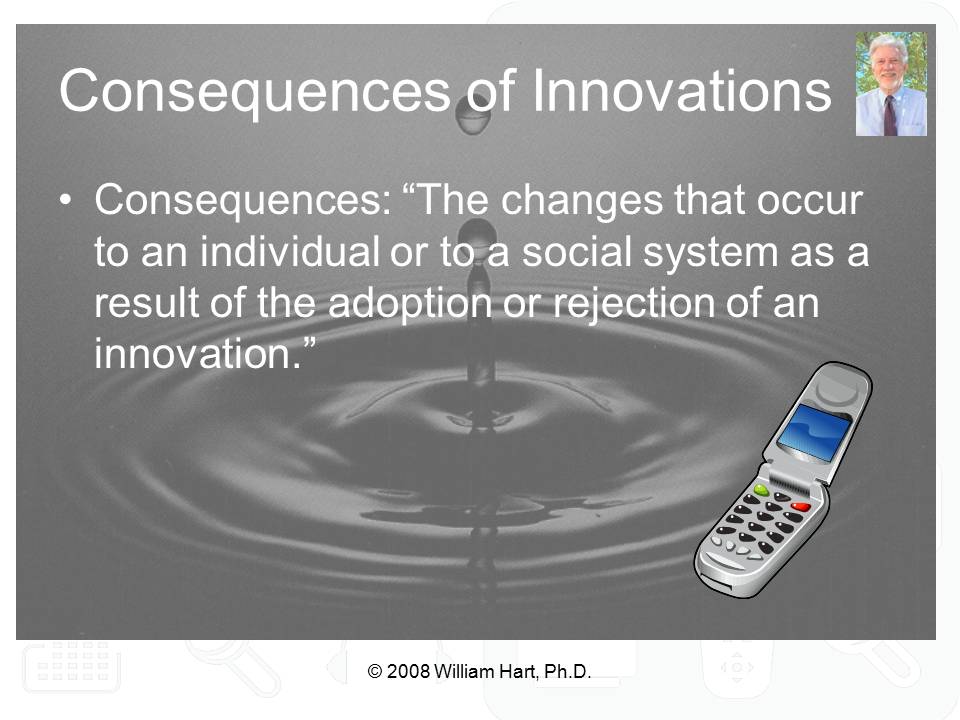
MediaTheory: Diffusion and Consequences of Adoption (W9-P5) F18


If I say popcorn and cell phones, what pops into your mind?  Excuse the pun.  Pop.

Seen the videos on the Internet that show people using cell phones to pop popcorn?

Are there health concerns you have when using cell phones?
That is, is there a serious consequence of us adopting cell phones?

Watch the video and do a little thinking.  


-------------


Think of desirable and undesirable consequences as the good and bad consequences of adopting an innovation.  Desirable = good, positive.  Undesirable = bad, negative.

What would be some desirable or good consequences of university students adopting cell/smartphones?
What would be some undesirable consequences?


As for direct and indirect, think of consequences as chain of consequences.

Adopt an innovation ---> direct consequence  ---> indirect consequence  -----> indirect consequence.

For example, if you adopt a new 3-D HDTV, then you can then you invite all your friends over and be "the talk of the town."  Now, that you are popular among your friends, you fell the pressure to keep inviting your new "friends" over (indirect consequence).  Now you lose time and money time and money entertaining your new friends (indirect consequence).  Which leads to you not having the time to spend on other important things in your life (indirect consequence).  The loss of time is not a direct consequence, but an indirect consequence.

Anticipated consequences are those that you think are going to happen if you adopt the innovation.  The unanticipated consequences are those that you don't see coming.  For example, you adopt that newest, expensive, tech toy and it is great.  You can do all sorts of things with it.  However, you didn't think about the struggle of paying off the bill for the new toy.


Another, especially important consequence of technological adoption.


Quickly browse some the Current News on the Digital Divide

2018 example: Eliminating the digital divide -PBS (see at least first 4 minutes).


Share this post with others. See the Twitter, Facebook and other buttons below.
Please follow, add, friend or subscribe to help support this blog.
See more about me at my web site WilliamHartPhD.com.


MediaTheory: Diffusion and the Rate of Adoption (W9-P4) F18


What makes an innovation spread?  What makes the rate of adoption increase?  What are the key factors according to diffusion of innovations theory?  What are the characteristics (or attributes) of an innovation that makes it quickly become adopted?  


Specifically, what are the attributes of the innovation that make it spread?


Let's first think about these attributes in the context of early radio?  Do you see the attributes mentioned in the adoption of early radio.

See from about 0:30 to about 9:00 in the video below.


Now, how do these attributes of an innovation apply to the diffusion of social media like Facebook, Twitter, etc.?


Share this post with others. See the Twitter, Facebook and other buttons below.
Please follow, add, friend or subscribe to help support this blog.
See more about me at my web site WilliamHartPhD.com.


MediaTheory: Diffusion of Innovations (W9-P3) F18


Everett M. Rogers' Diffusion of Innovations

Diffusion of innovation: “the process by which an innovation is communicated through certain channels over time among the members of a social system.”(Rogers).  

The graph below shows how people in a society over time adopt an innovation.

At first nobody had a TV in the U.S., but over time...


How does this theory help us understand how media technologies develop?  Does it help us understand the future of media technologies?


Source: Diffusion of Innovations, 5th Edition


In his book, Rogers explains the process people go through when adopting an innovation, more specifically the decision process.

See below.


    Source: Diffusion of Innovations, 4th ed.


    We can boil the decision process down to just five steps.


    Rogers’ model for the adoption decision process

    What are the steps in the adoption decision process?
    1. "Knowledge - learning about the existence and function of the innovation
    2. Persuasion - becoming convinced of the value of the innovation
    3. Decision - committing to the adoption of the innovation
    4. Implementation - putting it to use
    5. Confirmation - the ultimate acceptance (or rejection) of the innovation”

    Think carefully about the most recent new tech you bought, I mean adopted.  Did you go through this process?  Review the process above and think about it.

    What was the tech?  How did you learn about the new tech?  How were you persuaded to get it?  What about the rest of the process?


    Share this post with others. See the Twitter, Facebook and other buttons below.
    Please follow, add, friend or subscribe to help support this blog.
    See more about me at my web site WilliamHartPhD.com.


    MediaTheory: Agenda Setting Theory and Paradigms (W9-P2) F18


    Earlier we talked about Thomas Kuhn's ideas of paradigms, paradigm shifts and how theories grow and change of time, i.e. how they evolve.  In our look at agenda-setting theory, let's see how Kuhn's ideas apply to the development of agenda setting theory.  

    But, first let's start with a good grasp of the basics of agenda-setting theory.


    Did you spot the parts of paradigmatic history just in this short video?

    Rogers, E. M., Hart, W. B. & Dearing, J. W. (1997). A paradigmatic history of agenda-setting research. In S. Iyengar & R. Reeves (Eds.). Do the Media Govern?: Politicians, Voters, and Reporters in America (pp. 225-236). Thousand Oaks: CA, Sage Publications.

    Could you tell the paradigmatic history of agenda-setting research?  What would be on that list or timeline?


    Share this post with others. See the Twitter, Facebook and other buttons below.
    Please follow, add, friend or subscribe to help support this blog.
    See more about me at my web site WilliamHartPhD.com.


    MediaTheory: Cultivation Theory (W9-P1) Fa18


    Now, let's look at media theories that operate at the more sociological level.

    First, let's look at cultivation theory.  "The central tenet [of cultivation theory] is that heavy viewing literally cultivates a common view of the world" (Rosenberry & Vicker, p. 105).   According to George Gerbner, when using cultivation theory, we are looking at the long-term effects of repeated viewing has on an audience.  Here we are not looking at the immediate, one-time effect of a single media program, like the War of the Worlds broadcast.

    Everyday definition of cultivate: "to prepare or prepare and use for the raising of crops... also: to loosen or break up the soil about (growing plants)" (Merriam-Webster Dictionary).

    Compare Gerbner's use of the term with how a farmer uses the term.  Similarities?


    Share this post with others. See the Twitter, Facebook and other buttons below.
    Please follow, add, friend or subscribe to help support this blog.
    See more about me at my web site WilliamHartPhD.com.


    Monday, October 1, 2018

    Media Theory: Entertainment Education and Social Learning Theory (W7-P3) Fa18


    Entertainment education is based on a variety of theoretical frameworks.  One of those is Albert Bandura's social learning theory.


    If you are interested, I would also suggest this video for some more background on Bandura and social learning theory.


    Below is another example of entertainment education.  Tim Reid, noted Norfolk State University alumnus and actor/director/producer, and NSU students (Maryna Kariuk and Shimira Cole) were involved in the making of "Hear My Son".  How exactly is this an example of entertainment education?  How is social learning theory relevant here?


    Hear My Son from Legacy Media Institute on Vimeo.


    One of the key originators of the entertainment education concept is Miguel Sabido.  He used entertainment education strategies in television, specifically soap operas in Mexico and other countries.

    Sabido developed a theory for the construction of successful entertainment education projects.  It was perhaps more a meta-theory in that it brought together a variety of theories from a variety of fields into one meta-theory.

    One theory that Sabido drew upon was that of Bandura's social learning theory. Two key concepts in social learning theory are imitation and identification.

    imitation"The direct reproduction of observed behavior" (Baran & Davis, p. 170).

    identification"A special form of imitation that springs from wanting to be and trying to be like an observed model relative to some broader characteristics or qualities" (Baran & Davis, p. 170).

    Do you see how Bandura's concepts of imitation and identification fit in the videos above?

    If you were to create a development communication project that was entertainment education media project, how would you use social learning theory and the other theories used in E-E?


    Share this post with others. See the Twitter, Facebook and other buttons below.
    Please follow, add, friend or subscribe to help support this blog.
    See more about me at my web site WilliamHartPhD.com.